
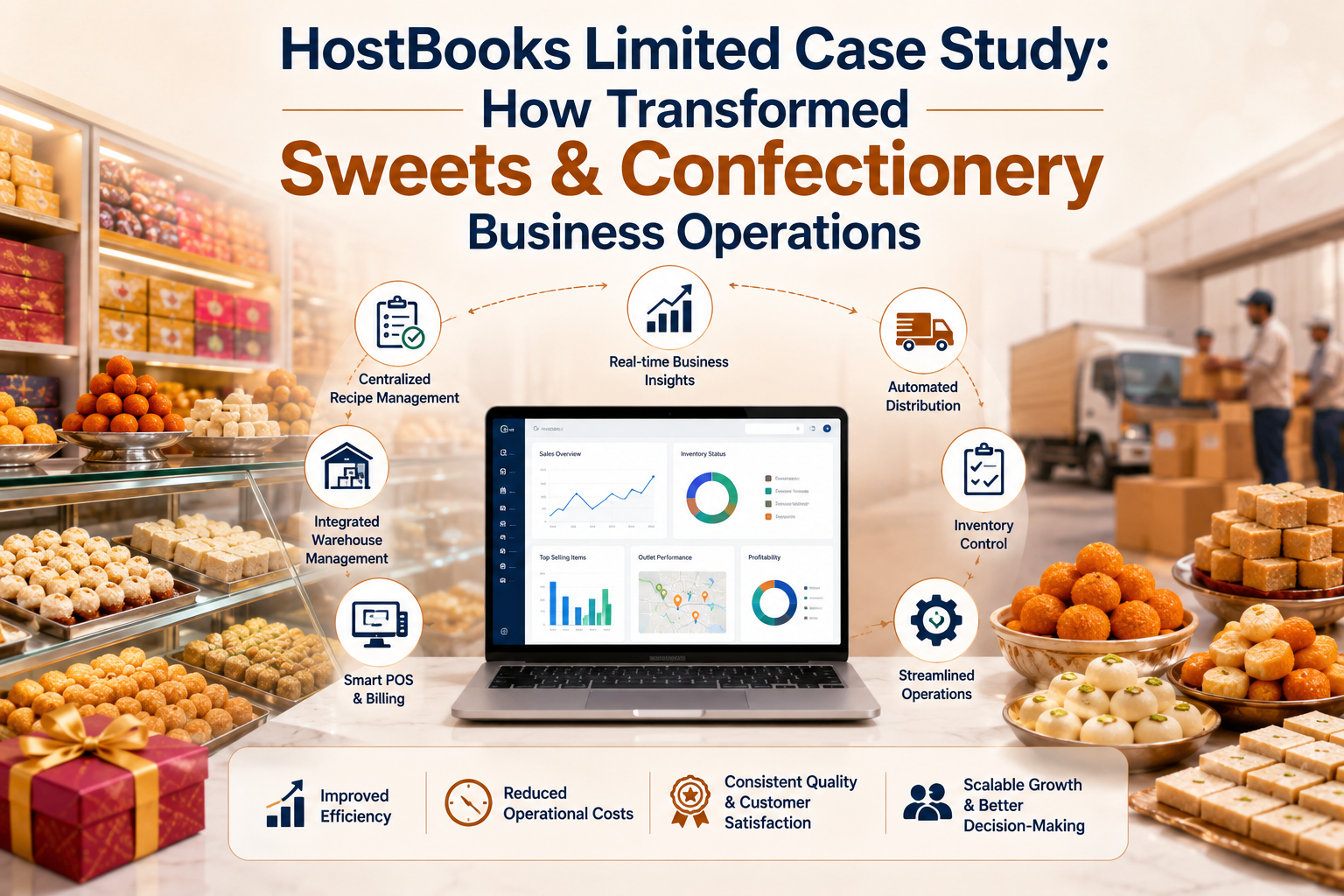
The Indian sweets and confectionery industry is one of the fastest-growing segments in the food and beverage sector. However, managing multiple outlets, maintaining consistent product quality, controlling inventory, and ensuring compliance can become increasingly complex as businesses expand. This HostBooks Limited Case Study highlights how a leading sweets and confectionery brand successfully transformed its operations using HB FnB360, HostBooks' ERP solution designed specifically for the food and beverage industry.
By replacing manual processes with an integrated ERP platform, the company streamlined inventory management, centralized recipes, improved sales reporting, and gained complete operational visibility across all locations.
About the Company
Established in 1994, Gwalia Sweets has become one of Gujarat's most recognized sweets and confectionery brands. With more than 30 retail outlets spread across Ahmedabad and other cities, the company serves thousands of customers every day with traditional Indian sweets, snacks, bakery products, and festive delicacies.
As customer demand increased and new outlets were added, managing operations through disconnected systems became increasingly difficult. The organization needed a centralized solution capable of handling procurement, production, inventory, billing, finance, and reporting from a single platform.
Business Challenges
Like many growing food businesses, the company encountered several operational bottlenecks that affected efficiency and profitability.
1. Multiple Standalone Systems
Different departments used separate software and spreadsheets for inventory, accounting, procurement, and sales. This created duplicate work, inconsistent information, and delayed reporting.
2. Lack of Centralized Recipe Management
Maintaining identical taste and quality across all outlets became increasingly difficult because recipes and production standards were not centrally managed.
3. Inventory Management Issues
Perishable ingredients require accurate stock monitoring. Overstocking increased wastage, while shortages affected production schedules and customer satisfaction.
4. Manual Distribution Process
Coordinating deliveries from the central warehouse to multiple retail outlets required considerable manual effort and often resulted in delays.
5. Delayed Business Reporting
Management struggled to obtain real-time information regarding sales, inventory movement, profitability, and outlet performance, making strategic decisions slower.
6. Scaling Operations
As the company expanded, manual workflows became inefficient and difficult to manage consistently across every location.
The HostBooks Solution: HB FnB360
To overcome these challenges, the company implemented HB FnB360, HostBooks' industry-specific ERP platform for food and beverage businesses.
Rather than introducing multiple software applications, HB FnB360 unified all business functions into one integrated ecosystem.
The implementation focused on improving automation, operational visibility, and centralized management.
Key Features Implemented
Centralized Recipe Management
One of the biggest improvements came from storing every recipe in a centralized database.
Benefits included:
- Standardized product quality
- Consistent taste across outlets
- Reduced dependency on individual staff
- Better production planning
- Accurate ingredient consumption
Recipe standardization also enabled the business to maintain its brand reputation while expanding into new markets.
Integrated Warehouse Management
HB FnB360 connected the central warehouse with every retail outlet.
This provided:
- Live inventory visibility
- Faster stock replenishment
- Improved purchase planning
- Better batch tracking
- Reduced inventory discrepancies
Warehouse teams could now monitor stock movement in real time instead of relying on manual updates.
Smart Point of Sale (POS)
The integrated POS system simplified retail operations.
Features included:
- Faster billing
- Centralized sales monitoring
- Digital payment integration
- Real-time transaction synchronization
- Improved customer service
Corporate management could instantly monitor sales across all stores without waiting for daily reports.
Automated Distribution
The ERP automated the movement of inventory between warehouses and retail outlets.
This helped the business:
- Reduce manual intervention
- Improve delivery accuracy
- Speed up stock transfers
- Minimize operational errors
- Maintain product availability
The distribution network became faster and more reliable.
Real-Time Business Intelligence
Management dashboards provided instant visibility into:
- Sales performance
- Inventory levels
- Purchase trends
- Outlet profitability
- Product performance
- Financial reports
This allowed faster, data-driven business decisions instead of relying on delayed manual reporting.
Business Transformation
The implementation of HB FnB360 significantly improved operational efficiency across the organization.
Some major improvements included:
Improved Productivity
Automation eliminated repetitive manual tasks, allowing employees to focus on higher-value business activities.
Better Inventory Control
Live inventory tracking reduced unnecessary stock accumulation while ensuring ingredients remained available for production.
Consistent Product Quality
Centralized recipes ensured customers experienced the same taste and quality regardless of which outlet they visited.
Faster Decision-Making
Real-time reports enabled management to respond quickly to changing customer demand and operational issues.
Reduced Operational Complexity
Instead of managing multiple disconnected applications, every department now worked on a single ERP platform.
Measurable Results
According to the HostBooks case study, the ERP implementation delivered significant operational improvements.
Key outcomes included:
- Approximately 80% reduction in reporting-related issues
- Streamlined management of multiple retail outlets
- Significant savings in time and operational effort
- Improved coordination between warehouse and stores
- Faster and more accurate business reporting
- Greater operational consistency through centralized management
Why ERP Matters for the Sweets & Confectionery Industry
Businesses in the sweets industry face unique operational challenges that generic ERP systems often fail to address.
Industry-specific solutions like HB FnB360 provide features such as:
- Batch production management
- Recipe costing
- Shelf-life monitoring
- Inventory optimization
- Central kitchen management
- Multi-outlet coordination
- POS integration
- Financial compliance
- Procurement automation
- Sales analytics
These capabilities help businesses reduce wastage while improving profitability and customer satisfaction.
Lessons from This HostBooks Limited Case Study
Several important lessons emerge from this successful ERP implementation:
- Digital transformation is essential for scaling food businesses.
- Centralized data improves operational accuracy.
- Automation reduces manual errors and increases productivity.
- Real-time reporting enables faster strategic decisions.
- Industry-specific ERP systems deliver greater value than generic software.
The company's experience demonstrates that technology can become a competitive advantage when implemented strategically.
Conclusion
This HostBooks Limited Case Study demonstrates how HB FnB360 successfully transformed the operations of a leading sweets and confectionery business. By replacing fragmented systems with a centralized ERP platform, the company achieved better inventory control, standardized recipes, automated distribution, faster reporting, and improved management across all retail outlets.
The implementation not only solved existing operational challenges but also created a scalable foundation for future growth. For sweets manufacturers, bakeries, and multi-outlet food businesses looking to modernize their operations, this case study highlights the value of adopting an industry-focused ERP solution that integrates production, inventory, sales, finance, and compliance into one intelligent platform.